Features Specifications Appliaction Download
Products Motion Control Remote I/O System EtherCAT Juction
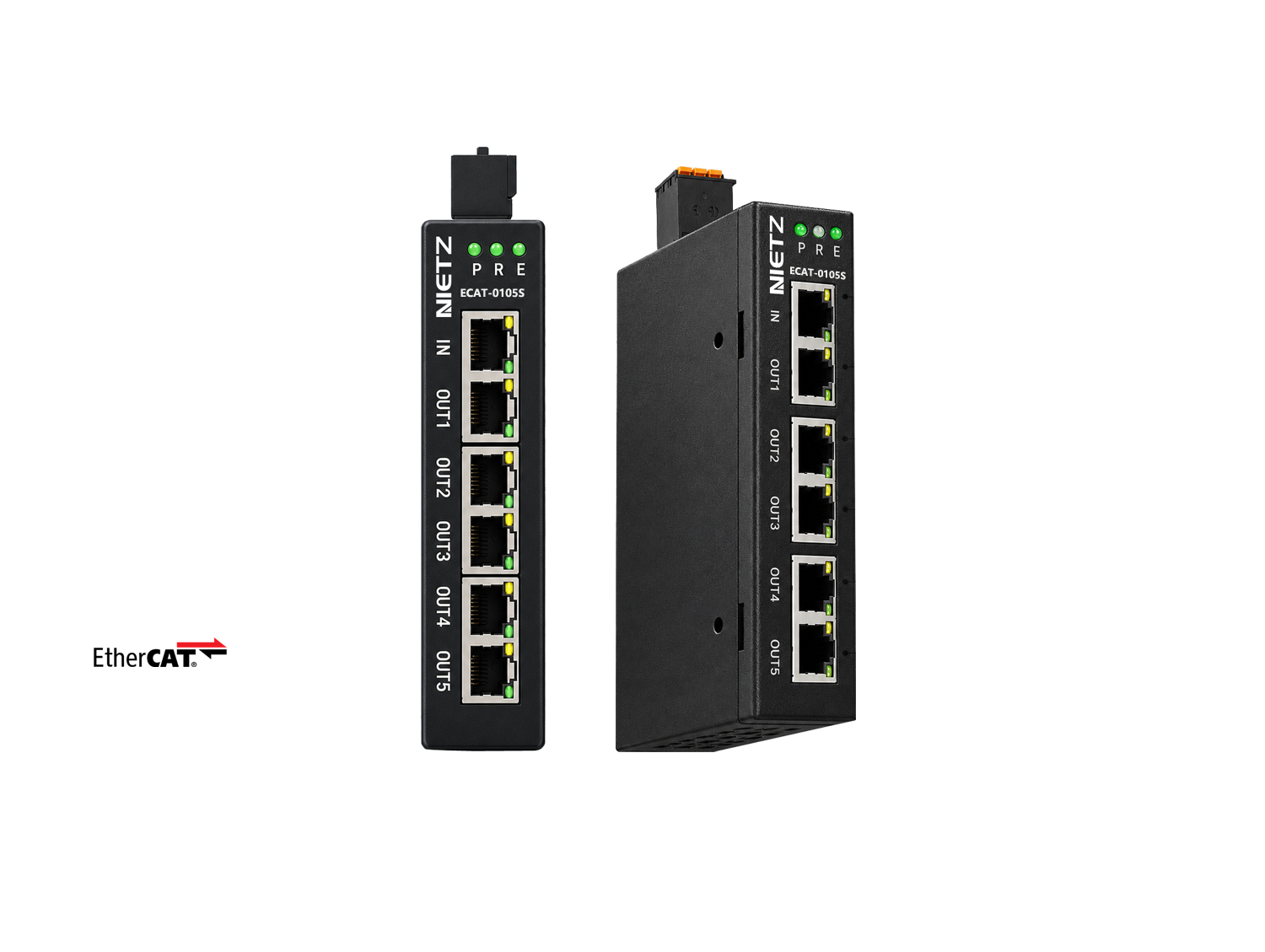
ECAT-0105S 6-Port EtherCAT junction SubDevice Module

An EtherCAT junction allows you to wire network devices into separated sections or branch lines, which prevents a single device failure from crashing the entire network.
Benefits of Separated EtherCAT Junctions

Isolated Failures: If a cable disconnects or a slave device fails in one branch, only that specific separated section stops working; the rest of the network keeps communicating with the master controller.
Easier Debugging: Maintenance staff can troubleshoot one isolated section or machine module without shutting down or diagnosing the whole system.
Flexible Topologies: Junctions enable tree, star, and drop-line branch configurations instead of a strict single daisy-chain path.
Hot Connect Support: You can plug or unplug specific machine segments and junction branches while the network remains fully powered and run
The  ECAT-0105S EtherCAT junction can be used in an EtherCAT Terminal segment at any desired position between the EtherCAT Terminals and enables configuration of EtherCAT star topologies.
A modular EtherCAT star hub can be realized by using several ECAT-0105S Module in a station.

Features

6-Port EtherCAT junction SubDevice Module

Maximum distance between stations up to 100 meters

Supports daisy-chain, star, tree, and hybrid network topologies

Each port features 4kV contact ESD (Electrostatic Discharge) protection

Introduction

The ECAT-0105S is an EtherCAT junction SubDevice Module featuring one input and five outputs. Designed to enable flexible and easily maintainable cabling deployments, it supports the free combination of line, star, and tree topologies.

Application Advantages

Advantage 1: Transition from daisy-chain to multi-branch topologies

The EtherCAT junction SubDevice Module supports star, tree, and hybrid branch cabling topologies. Compared to traditional daisy-chain topologies, branch topologies simplify cabling and are well-suited for field environments where devices are distributed across a wide area.

Advantage 2: Improved commissioning efficiency

In a traditional daisy-chain topology, if a single slave module fails or a cable disconnects, all downstream slave modules lose communication with the master controller.

By using the EtherCAT junction SubDevice Module, cabling can be segmented according to individual output ports. If a slave module on one output branch fails, only the modules on that specific branch are affected; slave modules connected to other output ports maintain communication with the master controller. Commissioning and troubleshooting can be performed branch-by-branch, significantly enhancing efficiency.


Specifications

Technical Features

ProductsEtherCAT junction SubDevice Module
Ports6 x RJ-45 (1 IN; 5-OUT)
Limit Current2A / 3A / 4A
VoltageDC 22~26V
Power Consumption0.08A
Wire size24 AWG / 22 AWG / 20AWG
Operation Temperature-20℃ ~  +60 ℃
Storage Temperature-25℃ ~  +75 ℃
Dimension
130x72x29mm (L x H x W)
InstallationDIN-Rail
CasingIron
Protective Class IP20